 Official U.S. shop
Joint care guide
Senior Dog Joint Guide: What Actually Helps an Older Dog Move Better
Keep your senior dog lean, walk short and often on soft ground, make the house easier to move around, and book checkups at least twice a year. Vet-prescribed pain medicine helps arthritis most predictably, and fish oil omega-3 has the best supplement evidence. Mighty K9 has no dog joint study, so treat it as a small add-on at most.
Written by the Mighty K9 editorial teamUpdated
The basics
Why do senior dogs get stiff joints?
Most stiffness in older dogs comes from osteoarthritis, a slow wearing of the cartilage and lining inside a joint. It may affect close to 40% of dogs (AAHA, Pain guidelines), and owners usually notice it somewhere between 5 and 13 years of age (Merck Vet Manual, Osteoarthritis).
Senior pets make up 44% of the pet population (AAHA, Senior care). Old age is not a disease, though, and a stiff dog often has pain that can be managed.

Step 1
Does weight loss really help a senior dog's joints?
Yes. Surgeons rank a slender body weight as the single most critical part of managing arthritis (ACVS, Osteoarthritis). Less weight means less load on every step,.
48 Labrador Retrievers in pairs; one dog in each pair ate 25% less for life (Kealy et al., 2002). The lifespan figures come from the sponsor's summary. No supplement was tested: the only difference was body weight.
In that study, hip arthritis on X-ray climbed from 15% of dogs at age 2 to 67% by age 14 (Smith et al., 2006). The leaner half held it off for years. Yet vets rate 59% of U.S. dogs as overweight, and over a third of owners of heavy dogs think their dog looks normal or thin (APOP, 2022 survey).
- Ask your vet for a body condition score at every visit, not just a weight.
- You should feel the ribs easily under a thin layer of fat and see a waist from above.
- Count treats, chews and oils. WSAVA keeps extras at 10% of the diet or less (WSAVA, Choosing food).
Step 2
What exercise is best for a senior dog with stiff joints?
Short, regular, low-impact movement keeps muscles strong and joints moving. Big bursts on the weekend do the opposite.
Two or three short walks
Fifteen to twenty minutes at an easy pace, on grass or dirt when you can. A 70 lb Lab with sore hips often does better with three short walks than one long one.
Swimming and water walking
Water carries much of the body weight. Ask your vet if it suits your dog.
Ball chasing and jumping
Sudden stops and leaps stress sore joints. Try sniff games and short rolls instead.
A day in the life
What does a joint-friendly day look like for an older dog?
Movement in small doses, rest on a good bed and meals at the same time each day.
- Breakfast, about 7:30
Drizzle 2 mL over the meal and mix. The sales FAQ says once daily in food; the same meal each day is easiest to remember.
- Or with dinner
If mornings are rushed, dinner works just as well. Pick one meal and stick to it.
- Walks
Short, regular walks on soft ground suit stiff seniors better than one long weekend outing.
- Rest
A padded bed off cold floors helps an older dog rise more easily. Watch how the first steps of the morning look.
Timing is a suggestion: the label and sales FAQ say only "once daily" in food. Weight and activity matter most for joints (ACVS, Osteoarthritis).
Step 3
How can you make your home easier for a stiff senior dog?
Small changes to floors and furniture cut slips and hard landings. Most cost little and take an afternoon.
| Change | Why it helps | Tip |
|---|---|---|
| Rugs or runners on slick floors | Paws slide on tile and wood, and splayed legs strain hips and knees | Use non-slip backing; trim long nails and paw fur too |
| Ramps or steps to the couch, bed or car | Jumping down lands the full body weight on the front legs | Pick a ramp with a grippy surface and a gentle slope |
| Thick orthopedic bed | Cushions bony points and makes rising easier | Keep it off cold floors and away from drafts |
| Raised food bowls | May ease neck and front-leg strain in some dogs | Use only if your vet says so; it is not right for every dog |
Step 4
How often should a senior dog see the vet?
Most vets suggest every 6 months. The 2023 AAHA senior care guidelines call for regular, systematic checkups because problems build slowly and owners miss them (AAHA, Senior care).
Bring notes on rising, stairs and walk length. Short phone videos help, because many dogs act perky in the exam room.
- Ask for a body condition score and a muscle condition score.
- Ask if a scoring sheet like the Canine Brief Pain Inventory makes sense for tracking (Brown et al., 2008).
Step 5
What pain medicine do vets use for dog arthritis?
Vets most often prescribe NSAIDs made for dogs, such as carprofen, meloxicam or grapiprant. The Merck Veterinary Manual calls NSAIDs the most predictably effective treatment for arthritis in dogs (Merck Vet Manual, Osteoarthritis), and the AAHA pain guidelines place them in the first tier (AAHA, Pain guidelines).
Ibuprofen, naproxen and similar drugs can cause stomach ulcers and kidney damage in dogs. Only give pain medicine your vet prescribes, at the dose they set.
Your vet may add injections, rehab or a prescription joint diet over time. Tell your vet about every supplement you give, oils included.
Supplements
Which joint supplement has the best evidence for dogs?
Omega-3 fatty acids from fish oil, by a clear margin. A 2012 review of 22 papers found poor evidence for nutraceuticals except omega-3 diets (Vandeweerd et al., 2012). A 2022 review of 72 trials found a clear benefit for omega-3 and a marked non-effect for glucosamine with chondroitin (Barbeau-Gregoire et al., 2022).
In one trial of 127 dogs at 18 clinics, owners of dogs on a fish-oil omega-3 food reported better rising and play by 6 weeks (Roush et al., 2010). The active parts are EPA and DHA. Olive oil contains none of either (USDA, Olive oil), so read our fish oil comparison before you pick.
Honest fit
Where does Mighty K9 fit in a senior dog joint plan?
At the very end, as a small add-on at most. Mighty K9 is olive oil with 1.6 mg of ESS60 per 2 mL serving, and no study has tested C60, ESS60 or the product for dog joints (PubMed search, C60 and dogs). The sales page says it supports joint function and eases everyday stiffness; no trial backs that wording.
In its favor
- Easy: a few drops on food once a day
- Three ingredients, full analysis printed
- Bacon flavor many dogs accept
- 30-day guarantee that counts empty bottles
Against it
- No dog joint data at all
- 16.2 kcal of fat per serving to count
- No EPA or DHA omega-3
- About $3.00 a day at $89.99 a bottle
If you do try it, check the serving size first and keep the same daily habits so you can judge it fairly. The ESS60 ingredient page lays out every animal study.
Your plan
What is the order of steps for a stiff senior dog?
Vet exam and pain plan
Rule out injury and set up medicine if your dog hurts.
Lean weight
Aim for ribs you can feel and a visible waist.
Gentle daily movement
Short walks on soft ground, every day.
Safer home
Rugs, ramps and a thick bed.
Evidence-based extras
Fish oil omega-3 first, other add-ons only with your vet's okay.
FAQ
Senior dog joint care FAQ
At what age is a dog considered a senior?
Most dogs count as seniors in the last quarter of their expected lifespan: often around 7 years for large breeds, 9 to 10 for small ones. Ask your vet when to start twice-yearly senior checkups for your dog.
What signs show my old dog's joints hurt?
Watch for stiffness after naps, slow rising, a shorter stride, skipping stairs or the couch, and licking at a joint. Grumpiness when touched can also be a pain sign. Our joint pain signs guide has a full table and tells you which signs need a vet visit the same day.
What helps a senior dog with stiff joints?
Give only what your vet approves. Prescription NSAIDs are the most reliable arthritis treatment, and fish oil omega-3 has the best supplement evidence. Keeping your dog lean helps more than any pill. Never give human pain relievers, which can harm dogs.
Can my dog stop its arthritis medicine and take Mighty K9 instead?
No. Mighty K9 is a food supplement, not a pain medicine, and it has no dog joint study. Keep giving any medicine your vet prescribed, and tell your vet before adding Mighty K9 so they can check the fat and calories against your dog's plan.
Should a dog with arthritis still go for walks?
Yes. Short, regular walks keep muscles strong and joints moving. Several easy walks on soft ground beat one long outing. If your dog is sore the next morning, shorten the walks and build back slowly.
How much weight should my senior dog lose?
Your vet should set the target, usually by body condition score. Most plans aim to lose about 1 to 2% of body weight a week. For a 70 lb Lab that is roughly 0.7 to 1.4 lb weekly. Losing too fast can cost muscle, which older dogs need.
Who wrote this
Written and reviewed by
Plain-language pages built from the label panel, the sales page and linked veterinary and public sources.
Last updated . Both our editorial standards and how we check reviews are open to read. This website is run by Themightyk9, the Mighty K9 U.S. shop and a stocking partner, not by the manufacturer. Buying through our order links earns us money.
Keep reading
More about Mighty K9

Joint pain signs
Stiffness after naps, the bunny hop, licking a joint: the arthritis signs owners miss, and when a limp is urgent.
Read more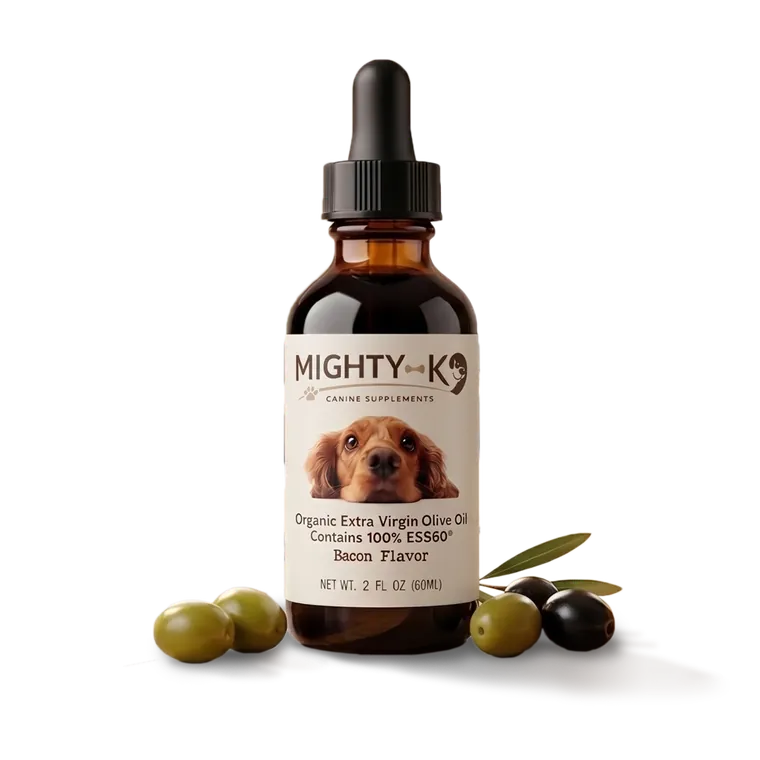
Mighty K9 vs fish oil
Fish oil omega-3 vs olive oil with C60 for dog joints: evidence, calories, cost per day and side effects.
Read more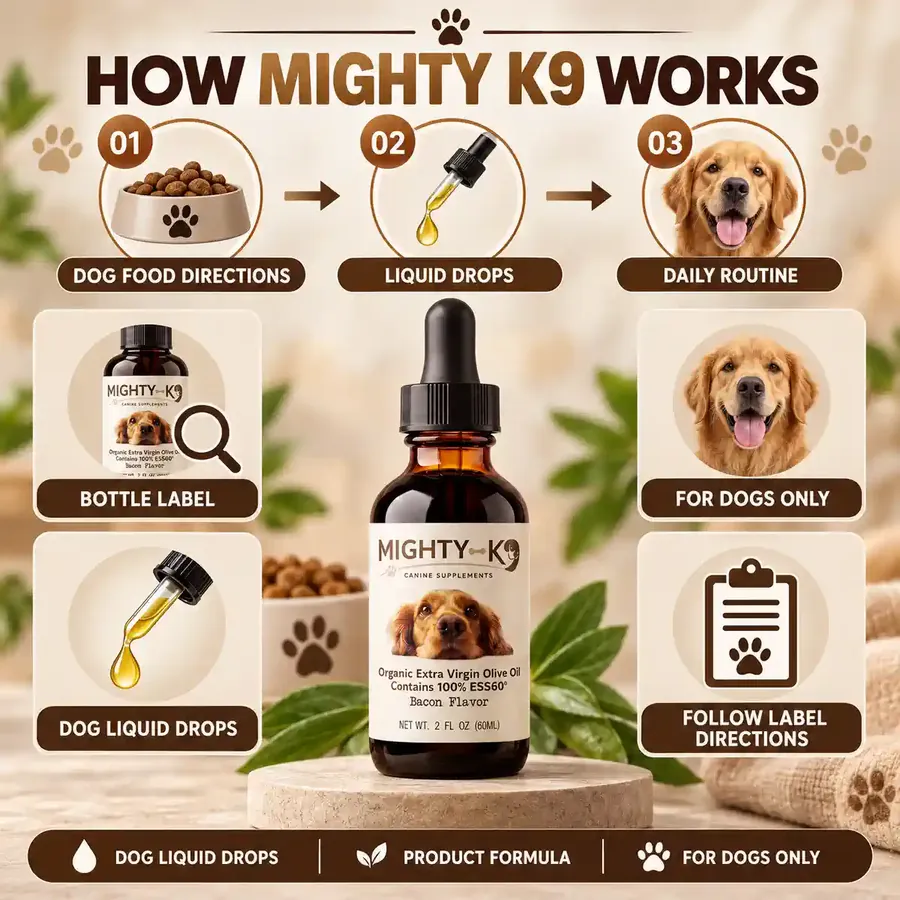
Serving size
The 2 mL label serving, what it adds in calories and ESS60 by dog size, and when to ask your vet.
Read moreMighty K9 U.S. shop, a stocking partner
Ready to try Mighty K9 with your dog?
Pick a pack. 2 mL on one meal a day; one bottle covers the whole 30-day money-back window.
- Secure checkout
- 30-day money-back window
- Ships from the U.S. with tracking